

(720) 414-6965
Call for a free consultation
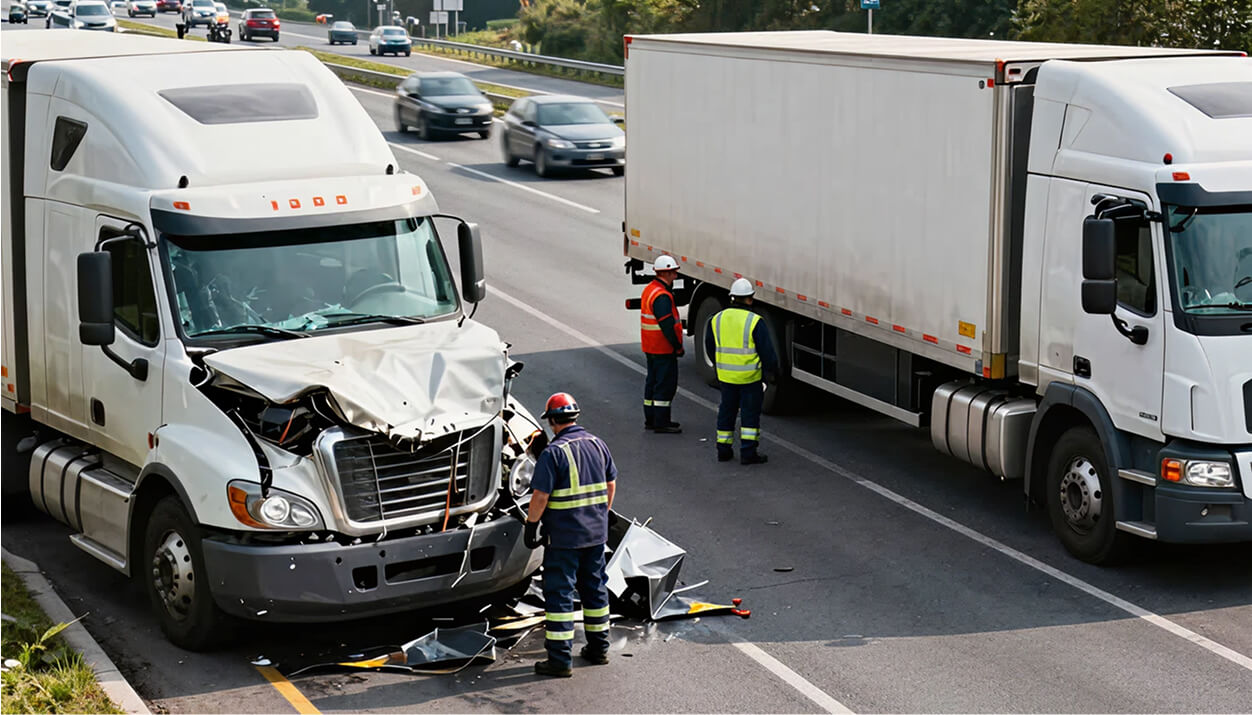
If you or a loved one has been injured in a crash involving a tractor-trailer, delivery truck, or other commercial vehicle, you need an experienced Denver truck accident attorney who understands the unique complexities of these cases. At Walker Law LLC, Denver truck accident attorney Jason Walker represents injury victims throughout Denver and across Colorado, pursuing full compensation from negligent truck drivers, trucking companies, and their insurers.
Unlike standard motor vehicle collisions, truck accident claims in Denver often involve federal safety regulations, corporate defendants, and aggressive insurance defense teams. Trucking companies and their insurers move quickly after a crash to protect their interests. Having a Denver truck accident lawyer who acts just as quickly can make a significant difference in the outcome of your case.
Jason Walker has extensive courtroom experience and a deep understanding of how insurance companies evaluate high-value claims. His background representing insurers earlier in his career now benefits injury victims throughout Denver and Colorado. When you hire a Denver truck accident attorney from Walker Law LLC, your case is prepared with precision, attention to detail, and trial readiness from day one.
Truck accidents in Denver frequently involve:
These cases are rarely simple. They often require preservation of electronic logging data, black box information, maintenance records, and driver qualification files. An experienced Denver truck accident attorney understands how to secure this evidence before it disappears.
Colorado law allows injury victims to pursue compensation when negligence causes harm. However, trucking companies and insurers often resist full accountability. A skilled Denver truck accident lawyer can help level the playing field and protect your right to recovery.
Truck accident litigation in Denver is fundamentally different from standard car accident cases. The size, weight, and commercial nature of large trucks create both greater danger and greater legal complexity. Working with a knowledgeable Denver truck accident attorney is critical when facing these challenges.
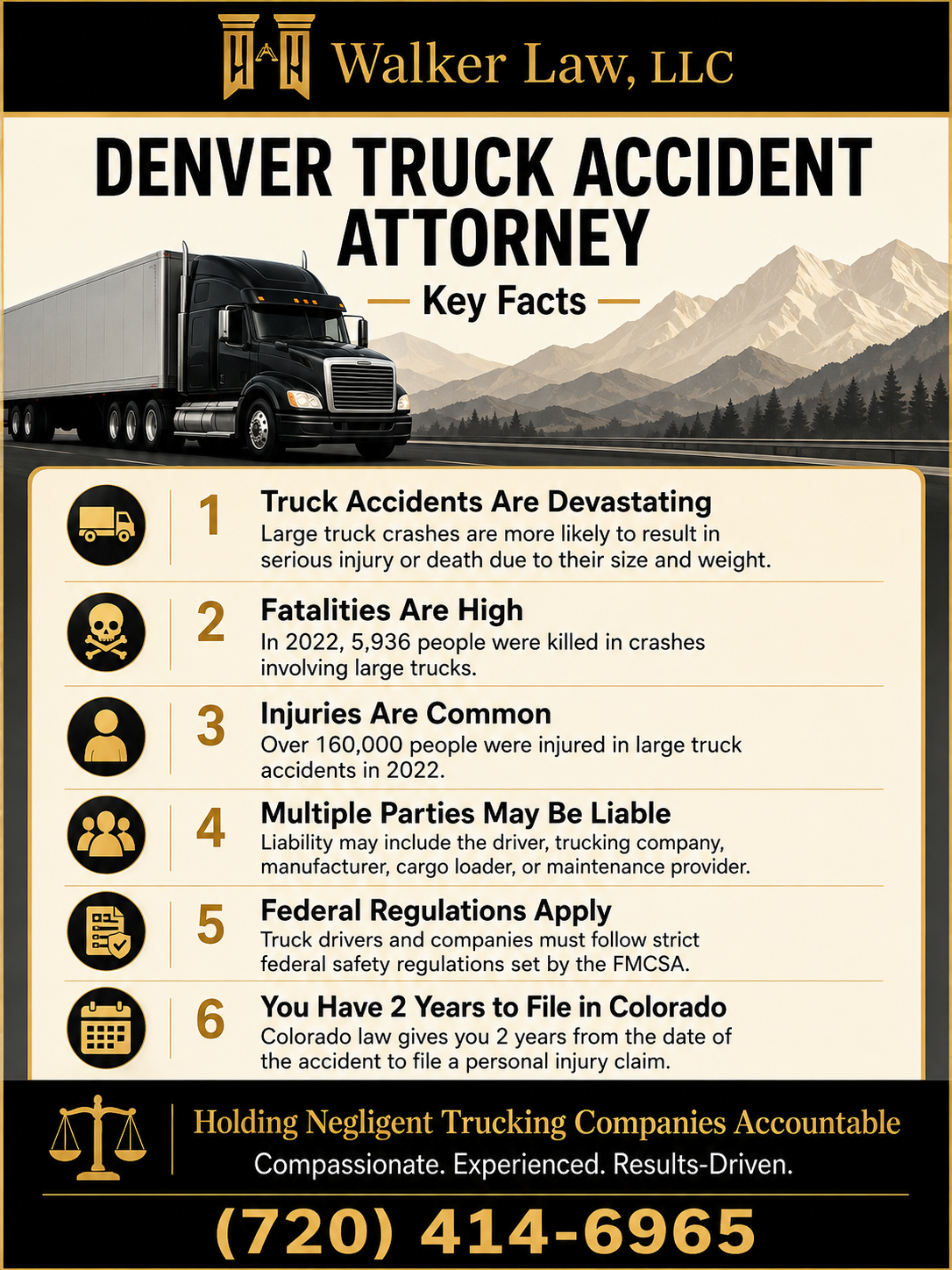
One major factor is federal regulation. Commercial trucking companies operating in Denver and throughout Colorado must comply with the Federal Motor Carrier Safety Regulations. These rules govern:
Violations of these regulations can establish powerful evidence in a Denver semi-truck accident case. A Denver truck accident attorney will review driver logs, electronic logging device data, and maintenance records to determine whether safety rules were ignored.
Another complicating factor is the number of potentially responsible parties. In a typical Denver truck accident, liability may extend beyond the driver to include:
Each of these parties may have separate insurance policies and legal teams. A seasoned Denver truck crash lawyer understands how to identify all available sources of recovery.
Trucking companies also deploy rapid response teams immediately after serious crashes in Denver. These teams are trained to gather evidence, interview witnesses, and limit corporate exposure. Without an experienced Denver truck accident attorney advocating on your behalf, critical evidence can be lost or controlled by the defense.
Finally, the financial stakes in Denver commercial truck accident cases are typically higher than in standard car crashes. Because injuries are often catastrophic, damages may include long-term medical care, permanent disability, and substantial lost earning capacity. Insurance companies defend these claims aggressively.
For all of these reasons, hiring a Denver truck accident lawyer with litigation experience is essential when pursuing compensation after a serious crash in Denver or anywhere in Colorado.
Truck accidents in Denver are often preventable. Federal and Colorado safety regulations exist specifically to reduce the risk posed by large commercial vehicles. When truck drivers or trucking companies cut corners, ignore safety rules, or prioritize profits over public safety, the results can be catastrophic. A skilled Denver truck accident attorney investigates these causes carefully to establish liability.
At Walker Law LLC, we represent victims injured in Denver semi-truck accidents caused by a wide range of negligent conduct.
Common causes of truck crashes in Denver include:
An experienced Denver truck accident attorney will review maintenance logs, driver qualification files, electronic logging device data, and onboard black box information to uncover safety violations. Establishing the precise cause of a Denver semi-truck accident strengthens the foundation of your claim and increases leverage during negotiations.
Because Colorado follows a modified comparative negligence rule, trucking companies frequently attempt to shift partial blame to injured victims. A knowledgeable Denver truck crash lawyer anticipates these tactics and builds a case that clearly demonstrates fault.
Not all truck accidents are the same. The size and configuration of commercial vehicles create different crash dynamics and injury patterns. As a dedicated Denver truck accident attorney, Jason Walker represents clients injured in a wide variety of commercial vehicle collisions across Denver and throughout Colorado.
Our firm handles cases involving:
These collisions often result in severe injuries, including traumatic brain injuries, spinal cord damage, complex fractures, and internal organ trauma. In the most tragic cases, families may need to pursue a wrongful death claim under Colorado law.
A Denver truck accident lawyer must evaluate not only how the crash occurred, but also the full scope of long-term consequences. Because trucking cases frequently involve significant insurance coverage limits, they are defended aggressively. Insurance carriers representing trucking companies in Denver often deploy experienced defense counsel to minimize exposure.
At Walker Law LLC, every case handled by a Denver truck accident attorney is prepared as though it may proceed to trial. This level of preparation strengthens negotiating power and demonstrates that our firm is ready to present evidence before a Colorado jury if necessary.
Because commercial trucks are significantly larger and heavier than passenger vehicles, the injuries resulting from a Denver semi-truck accident are often severe. Victims frequently require extensive medical treatment, long-term rehabilitation, and in some cases lifelong care. A knowledgeable Denver truck accident attorney must carefully document these injuries to pursue full compensation under Colorado law.
At Walker Law LLC, we represent individuals in Denver who have suffered catastrophic and life-altering harm due to negligent truck drivers and trucking companies.
Common injuries in Denver truck accident cases include:
When injuries are catastrophic, the financial impact extends far beyond immediate hospital bills. A skilled Denver truck accident lawyer evaluates future medical needs, long-term therapy, assistive devices, home modifications, and diminished earning capacity. Properly valuing these damages is essential, especially in cases involving permanent impairment.
In the most tragic circumstances, families may lose a loved one in a fatal Denver truck accident. In those cases, a Denver truck accident attorney can pursue a wrongful death claim under Colorado law to seek accountability and financial stability for surviving family members.
Because trucking companies and insurers understand the high financial exposure in catastrophic injury cases, they defend these claims aggressively. Comprehensive documentation and expert support are critical to building a strong case.
One of the most important roles of a Denver truck accident attorney is identifying every party that may share responsibility for a crash. Unlike standard car accidents, liability in a Denver commercial truck accident often extends beyond the individual driver.
Potentially liable parties may include:
Identifying all responsible parties is essential because commercial trucking policies often involve layered insurance coverage. A thorough investigation by an experienced Denver truck accident lawyer ensures that no potential source of compensation is overlooked.
Colorado’s modified comparative negligence rule makes fault analysis particularly important. Insurance companies frequently attempt to argue that the injured person in Denver was partially responsible for the crash. If a victim is found 50 percent or more at fault, recovery may be barred. A seasoned Denver truck accident attorney builds a strong evidentiary record to prevent unfair fault allocation.
By examining driver logs, employment records, maintenance documentation, and electronic data, Walker Law LLC works to uncover every contributing factor. Preparing each Denver truck accident case as though it will proceed to trial strengthens our firm’s position during settlement negotiations.
A serious trucking collision in Denver can create overwhelming financial and personal consequences. Because commercial truck accidents often result in catastrophic injuries, the damages in these cases are typically substantial. An experienced Denver truck accident attorney works to pursue full compensation for every category of loss recognized under Colorado law.
At Walker Law LLC, each Denver truck accident lawyer case begins with a detailed assessment of both current and future damages. Trucking companies and their insurers frequently attempt to minimize payouts, especially when exposure is high. Thorough documentation and strategic case development are essential.
Compensation in a Denver truck accident claim may include:
In cases involving egregious misconduct, such as knowingly violating federal safety regulations or driving under the influence, Colorado law may allow for exemplary damages designed to punish reckless behavior.
A skilled Denver truck accident attorney understands how to project future losses accurately. Because trucking cases often involve higher insurance policy limits than standard car accidents, insurers defend them aggressively. Working with a knowledgeable Denver commercial truck accident attorney ensures that no category of damages is overlooked.
After a serious crash in Denver, trucking companies and their insurers act quickly to limit financial exposure. Understanding these defense strategies is essential when selecting a Denver truck accident attorney.
In many Denver semi-truck accident cases, the trucking company deploys an immediate response team to the scene. These teams may include investigators, safety officers, and defense attorneys. Their objective is to gather evidence that protects the company’s interests.
Common defense tactics include:
Because these companies operate throughout Denver and across Colorado, they often have experienced legal teams prepared to litigate aggressively. Hiring a trial-ready Denver truck accident lawyer is critical to countering these strategies.
At Walker Law LLC, every Denver truck accident attorney case is prepared as though it will be presented to a jury. This includes preserving black box data, sending spoliation letters to prevent destruction of records, consulting accident reconstruction experts, and carefully documenting all damages.
Jason Walker’s background representing insurance companies earlier in his career provides valuable insight into how defense teams evaluate risk. That knowledge now benefits injured individuals throughout Denver. By anticipating defense tactics, a seasoned Denver truck crash lawyer can strengthen the client’s negotiating position.
When insurers refuse to offer fair compensation, filing a lawsuit in a Denver court may be necessary. Trial preparation sends a clear message that Walker Law LLC is ready to pursue accountability under Colorado law.
Selecting the right Denver truck accident attorney can significantly influence the outcome of your case. Trucking litigation involves complex federal regulations, multiple defendants, and high financial stakes. Walker Law LLC provides focused, experienced representation for victims throughout Denver and the surrounding metro area.
Jason Walker offers several advantages:
Truck accidents often cause life-changing injuries. A dedicated Denver truck accident lawyer must be prepared to stand up to large corporations and their insurers. Walker Law LLC approaches each Denver truck accident case with careful preparation, strategic negotiation, and readiness for trial.
If you or a loved one has been injured in a semi-truck or commercial vehicle crash in Denver, do not wait to seek legal guidance. Evidence in a Denver truck accident case can disappear quickly, and Colorado law limits the time you have to file a claim.
Walker Law LLC offers free consultations to individuals and families throughout Denver and across Colorado. During your consultation, a Denver truck accident attorney will review the details of your case, explain your legal options, and outline the next steps.
Taking action promptly can protect your right to pursue compensation for medical expenses, lost income, pain and suffering, and other damages resulting from a serious Denver truck crash.
To speak with an experienced Denver truck accident lawyer, call Walker Law LLC at (720) 414-6965 or contact our firm online to schedule your free consultation.
Reviewed for legal accuracy by Jason Walker on September 22, 2026
Driver fatigue may be investigated by comparing electronic logs, fuel receipts, toll records, delivery schedules, dispatch messages, and vehicle location data. Federal hours-of-service rules limit driving and on-duty time and require qualifying commercial drivers to take designated rest periods. Differences between a driver’s log and other records may suggest that working hours were inaccurately reported. Medical information, witness observations, cab video, and statements made after the truck accident may also provide evidence of fatigue. A Colorado attorney can use these records to determine whether an exhausted driver or a demanding trucking company contributed to the Denver collision.
Responsibility for an improperly loaded truck may extend beyond the person who was driving it. A trucking company, shipper, warehouse operator, loading contractor, trailer owner, or another business may have participated in loading or securing the cargo. Weight imbalance, overloading, and inadequate securement can contribute to rollovers, jackknife crashes, shifting cargo, or loss of steering control. An attorney may examine bills of lading, weight tickets, cargo photographs, loading procedures, and inspection records to identify the parties involved. This evidence can help determine whether unsafe cargo practices caused or worsened a truck accident in Denver, Colorado.
Bad weather does not automatically excuse a truck driver or trucking company from liability after a collision. Commercial drivers are generally expected to adjust their speed, following distance, and driving behavior to match road and weather conditions. Investigators may examine weather reports, road conditions, driver actions, and compliance with safety regulations when determining fault. A crash caused by excessive speed or unsafe driving during snow, rain, or icy conditions may still result in legal responsibility. A Denver truck accident attorney can evaluate whether weather or negligent driving played the greater role in the Colorado collision.
Truck accident cases often involve multiple parties, including drivers, trucking companies, maintenance providers, and cargo loaders. Investigators may need to review electronic logging devices, maintenance records, driver qualifications, and company safety policies. Federal and state trucking regulations can also play an important role in determining liability. Important evidence may disappear if it is not preserved quickly after the crash. An experienced truck accident attorney can take immediate steps to protect critical evidence.
Yes, trucking companies may be legally responsible for accidents caused by their employees in certain situations. They may also be liable if they failed to properly hire, train, supervise, or maintain their drivers and vehicles. Company safety practices and compliance with federal regulations are often examined during the investigation. Determining liability requires a careful review of employment records and operational procedures. An attorney can identify all potentially responsible parties to maximize your claim.
Compensation may include medical expenses, lost income, reduced earning capacity, pain and suffering, and property damage. In severe cases, future medical care and long-term rehabilitation costs may also be recoverable. Families may have additional legal options if the accident resulted in a wrongful death. Every claim depends on the specific facts, injuries, and available evidence. A lawyer can assess your losses and pursue the compensation you may be entitled to receive.
In 2026, important truck accident evidence may include electronic logging device data, driver duty-status records, dispatch communications, GPS information, and onboard vehicle data. Federal rules require many commercial drivers to use electronic logging devices to record driving and off-duty time. These records may help determine whether driver fatigue, excessive hours, speeding, or improper scheduling contributed to the collision. Trucking companies may retain different records for limited periods, making an early preservation request especially important. A Denver truck accident attorney can seek these materials before they are routinely deleted, overwritten, or lost.
Legal guidance should be sought promptly because trucking companies and their insurers may begin investigating a serious collision immediately. Early action can help preserve truck data, driver records, surveillance footage, damaged components, witness statements, and other evidence before it becomes unavailable. An attorney can also identify multiple responsible parties and insurance policies that may apply to the accident. Waiting too long may weaken the investigation and create problems with Colorado filing deadlines. To discuss the crash and the evidence that may need to be protected, reach out to us about your Denver truck accident case.