

(720) 414-6965
Call for a free consultation

If you were injured in a crash, speaking with an experienced Denver motorcycle accident attorney is essential. At Walker Law LLC, Denver motorcycle accident attorney Jason Walker represents riders throughout Denver and across Colorado who have suffered serious injuries due to careless or reckless drivers.
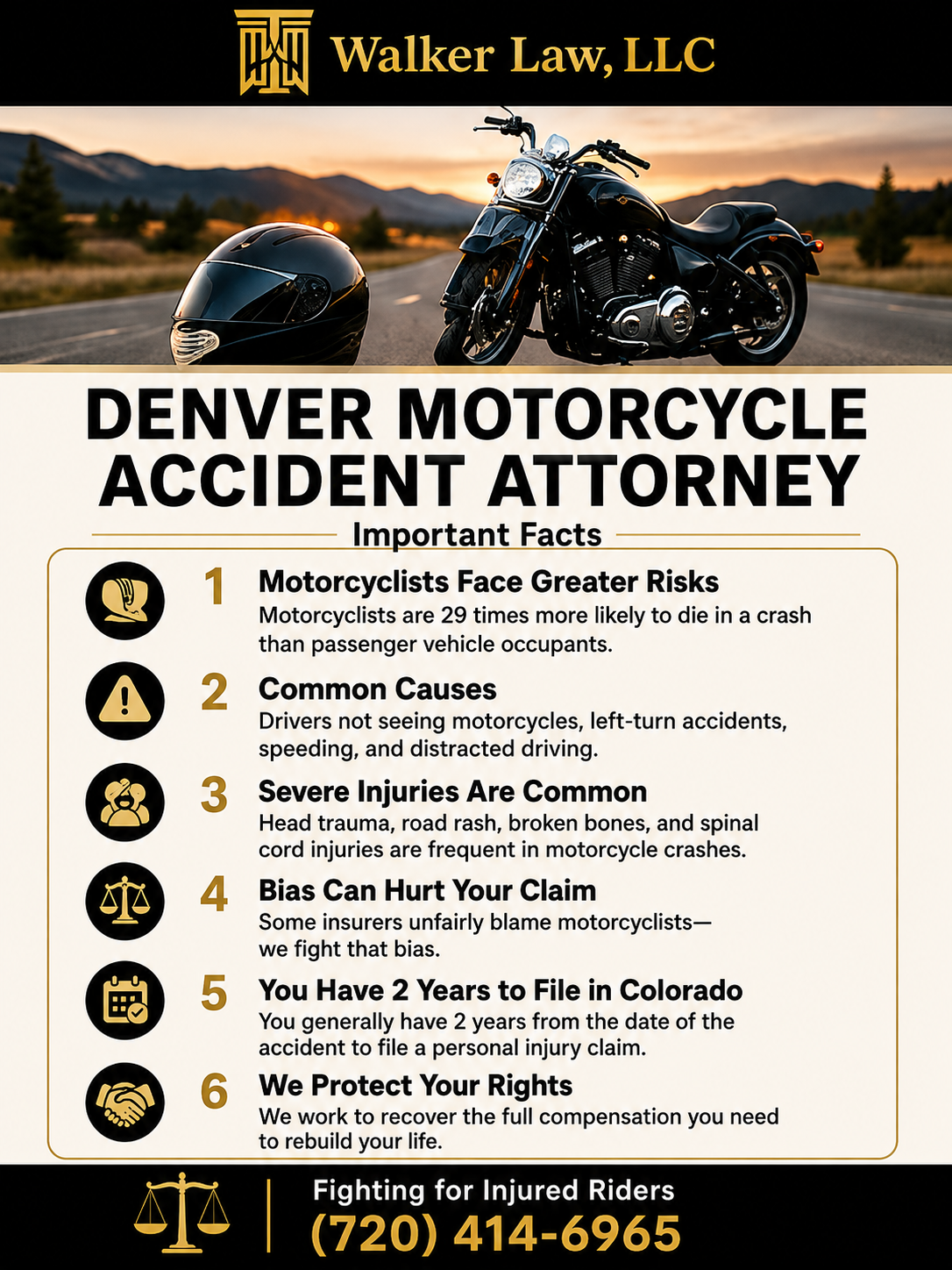
Motorcycle accident cases differ from standard car accident claims. They often involve severe injuries, disputes over visibility, and unfair assumptions about rider behavior. A knowledgeable Denver motorcycle accident lawyer understands the unique dynamics of motorcycle crashes and the tactics insurance companies use to shift blame.
Whether your accident occurred on I-25, I-70, a downtown Denver roadway, or a suburban intersection, Colorado law protects your right to pursue compensation. A skilled Denver motorcycle crash attorney will investigate the collision, preserve critical evidence, and build a case designed to withstand aggressive insurance defenses.
Motorcyclists in Denver deserve the same legal protection as any other driver on Colorado roads. When negligence causes harm, a dedicated Denver motorcycle injury lawyer works to pursue full and fair compensation.
Motorcycle accidents in Denver frequently result in more serious injuries than typical car collisions. The absence of a protective vehicle frame, airbags, and seatbelts leaves riders directly exposed to impact forces.
Several factors contribute to the severity of motorcycle crashes in Denver:
Colorado’s scenic highways and mountain routes attract many riders, but urban traffic in Denver presents its own hazards. A moment of inattention by a driver can lead to life-altering consequences for a motorcyclist.
Because motorcycle accident injuries are often severe, claims handled by a Denver motorcycle accident attorney frequently involve substantial medical expenses and long-term rehabilitation. Insurance carriers recognize the high financial exposure in these cases and often defend them aggressively.
Understanding why motorcycle crashes in Denver are so dangerous underscores the importance of immediate legal guidance. A skilled Denver motorcycle accident lawyer acts quickly to preserve accident scene evidence, obtain traffic camera footage, and interview witnesses before memories fade.
Most motorcycle accidents in Denver are caused by the negligence of other drivers. While motorcyclists are often unfairly blamed, investigations frequently reveal that a passenger vehicle driver failed to exercise reasonable care.
A skilled Denver motorcycle accident attorney carefully examines how the crash occurred and who was responsible.
Common causes of motorcycle accidents in Denver include:
Colorado law requires drivers to share the road safely with motorcyclists. When a driver fails to observe traffic laws or exercise reasonable caution, a Denver motorcycle accident lawyer works to hold that driver accountable.
Accident reconstruction, witness statements, traffic camera footage, and vehicle damage analysis often play key roles in determining fault. A knowledgeable Denver motorcycle crash attorney acts quickly to preserve this evidence before it is lost.
Motorcycle accident cases in Denver often involve an additional challenge: bias. Insurance adjusters, and sometimes even jurors, may hold assumptions about motorcyclists that influence how claims are evaluated.
A seasoned Denver motorcycle accident attorney understands how to counter these unfair stereotypes.
Common insurance tactics in Denver motorcycle accident claims include:
Colorado follows a modified comparative negligence system. If a motorcyclist in Denver is found 50 percent or more at fault, recovery may be barred. Even partial fault can reduce compensation. Insurance companies understand this and often attempt to assign blame to injured riders.
A skilled Denver motorcycle injury lawyer combats these tactics through:
By building a clear narrative supported by evidence, a Denver motorcycle accident attorney can demonstrate that the crash was caused by another driver’s negligence, not reckless riding.
Bias should never prevent an injured rider from obtaining fair compensation. In Denver and throughout Colorado, motorcyclists have the same legal rights as any other motorist. Effective representation ensures that those rights are protected.

Motorcycle crashes in Denver frequently result in severe and life-altering injuries. Because riders lack the structural protection afforded to occupants of passenger vehicles, the physical consequences of a collision are often catastrophic.
A knowledgeable Denver motorcycle accident attorney carefully evaluates the full extent of injuries to ensure that compensation reflects both immediate and long-term impacts.
Common injuries in Denver motorcycle accidents include:
The financial impact of these injuries can be substantial. Hospital stays, surgeries, rehabilitation, and long-term medical care may continue for months or years. A skilled Denver motorcycle injury lawyer works with medical professionals to project future treatment needs and permanent impairment.
Because motorcycle accident injuries are often severe, insurers may attempt to minimize the long-term effects. Detailed medical documentation and expert testimony are essential to building a strong claim in Denver courts.
When injuries are catastrophic, coordination with a Denver catastrophic injury attorney may be appropriate to ensure that every category of damages is fully evaluated under Colorado law.
Establishing liability is a critical step in any motorcycle accident claim. A seasoned Denver motorcycle accident attorney must demonstrate that another party’s negligence directly caused the crash and resulting injuries.
Proving fault in a Denver motorcycle crash often involves:
In some cases, electronic data from vehicles may help clarify speed, braking patterns, or steering inputs prior to impact.
Colorado’s modified comparative negligence rule makes fault analysis particularly important. If a motorcyclist in Denver is found 50 percent or more responsible for the accident, recovery may be barred. Even a smaller percentage of fault can reduce compensation.
Insurance companies frequently argue that a rider was speeding, weaving through traffic, or otherwise riding recklessly. A skilled Denver motorcycle accident lawyer anticipates these claims and counters them with evidence.
In certain cases, liability may extend beyond another driver. For example:
Identifying all responsible parties is essential to maximizing recovery. A knowledgeable Colorado motorcycle accident attorney conducts a thorough investigation to ensure that no potential source of compensation is overlooked.
Because evidence can disappear quickly, contacting a Denver motorcycle crash attorney as soon as possible after the accident helps preserve your legal rights.
A serious motorcycle crash in Denver can create overwhelming financial and personal hardship. Medical expenses often accumulate quickly, and time away from work can place additional strain on injured riders and their families. An experienced Denver motorcycle accident attorney works to pursue full compensation under Colorado law.
Depending on the circumstances of the accident, compensation in a Denver motorcycle accident claim may include:
Because motorcycle injuries are often severe, damages in a Denver motorcycle accident case can be substantial. Insurance companies understand this exposure and frequently attempt to reduce payouts through fault arguments or injury minimization.
A knowledgeable Denver motorcycle injury lawyer works with medical providers, vocational experts, and financial professionals to accurately calculate long-term losses. When necessary, expert testimony can help demonstrate the full impact of catastrophic injuries.
Colorado law imposes a three-year statute of limitations for most motor vehicle accident claims. Consulting a Denver motorcycle accident attorney promptly helps ensure that your rights are preserved.
Tragically, motorcycle accidents in Denver sometimes result in fatal injuries. When a rider loses their life due to another driver’s negligence, surviving family members may face both emotional devastation and financial uncertainty.
A compassionate Denver motorcycle accident attorney can help families understand their options under Colorado law.
In fatal motorcycle accident cases, eligible family members may pursue:
Common scenarios leading to fatal motorcycle accidents in Denver include:
A Denver fatal motorcycle accident attorney investigates the crash thoroughly to identify all responsible parties. In some cases, liability may extend beyond an individual driver to include an employer, trucking company, or other entity.
Colorado’s wrongful death statute establishes specific timelines and procedural rules. Acting quickly allows a Denver wrongful death attorney to preserve evidence and protect the family’s right to pursue compensation.
While no legal action can undo the loss of a loved one, a wrongful death claim can provide financial stability and hold negligent parties accountable. A dedicated Denver motorcycle accident lawyer approaches these cases with seriousness and respect for the magnitude of the loss.
Motorcycle accident claims require careful investigation, strategic planning, and readiness for litigation. Choosing the right Denver motorcycle accident attorney can significantly influence the outcome of your case.
Jason Walker offers meaningful advantages to injured riders in Denver:
Motorcyclists in Denver deserve strong representation when negligence causes serious harm. A skilled Denver motorcycle accident lawyer prepares each case thoroughly, anticipates defense tactics, and remains ready to proceed to trial if necessary.
Walker Law LLC represents injured riders across Denver and throughout Colorado with disciplined advocacy and strategic focus.
If you or a loved one has been injured in a motorcycle accident in Denver or the surrounding metro area, you may have the right to pursue compensation under Colorado law. Acting promptly helps preserve evidence and protect your claim.
Walker Law LLC offers free consultations to injured riders throughout Denver and across Colorado. During your consultation, a Denver motorcycle accident attorney will review the details of your crash, explain your legal options, and outline the next steps.
To speak with an experienced Denver motorcycle accident lawyer, call Walker Law LLC at (720) 414-6965 or contact our firm online to schedule your consultation.
Protect your rights with a trusted Denver motorcycle accident attorney committed to advocating for riders throughout Colorado.
Reviewed for legal accuracy by Jason Walker on September 22, 2026
Insurance adjusters may rely on unfair assumptions that motorcycle riders are reckless, aggressive, or willing to take unnecessary risks. These stereotypes can influence how an insurer evaluates fault, injuries, medical treatment, and the value of a motorcycle accident claim. Objective evidence such as video footage, witness statements, vehicle damage, electronic data, and accident reconstruction can help counter unsupported allegations. A Denver attorney can focus the case on the conduct of each driver rather than assumptions about the injured rider. Addressing bias early is important because Colorado comparative negligence rules may reduce or prevent recovery when fault is assigned to the motorcyclist.
Colorado generally permits adult motorcycle riders to operate without a helmet, although riders and passengers under 18 must wear approved protective headgear. An insurance company may still argue that the absence of a helmet caused or worsened a head injury. That argument does not automatically establish that the rider caused the motorcycle accident or that compensation should be denied. Medical experts may be needed to determine whether helmet use would have affected the specific injuries involved in the Denver crash. An attorney can challenge attempts to use helmet evidence unfairly when another driver’s negligence caused the Colorado collision.
A motorcycle accident may result from defective brakes, tires, steering components, fuel systems, or other mechanical parts rather than driver error alone. When a manufacturing or design defect contributes to a crash, the manufacturer, distributor, or another responsible company may be liable for the resulting injuries. Investigators may inspect the motorcycle, maintenance records, recall information, and damaged components to determine whether a defect played a role. Preserving the motorcycle after the collision can be important because repairs or disposal may destroy valuable evidence. A Denver motorcycle accident attorney can investigate whether a product liability claim should be pursued in addition to the motorcycle accident case.
Motorcycle modifications do not automatically prevent an injured rider from pursuing compensation after an accident. However, insurers may investigate whether aftermarket parts or custom equipment contributed to the collision or the severity of the injuries. Maintenance records, inspection reports, photographs, and expert analysis may help determine whether any modification was relevant to the crash. Many modifications have no connection to liability and should not be used to unfairly reduce a valid claim. A Denver motorcycle accident attorney can evaluate the evidence and address unsupported arguments related to customized motorcycles.
Motorcyclists have far less physical protection than occupants of passenger vehicles during a collision. Even relatively low-speed crashes can result in serious injuries such as fractures, road rash, or traumatic brain injuries. Recovery may require surgery, rehabilitation, and extended medical care. These injuries can also affect a person's ability to return to work or enjoy daily activities. A lawyer can help document these losses when seeking compensation.
Yes, hazards such as potholes, loose gravel, uneven pavement, or missing signs may contribute to a motorcycle accident. In some situations, a government agency or another responsible party may share liability for failing to maintain safe road conditions. Determining responsibility requires a careful investigation of the accident scene and available evidence. Prompt documentation of the roadway can be especially important before conditions change. An attorney can evaluate whether additional parties may be legally responsible.
In 2026, Colorado permits qualifying two-wheeled motorcycles to filter past stopped traffic when specific safety conditions are satisfied. The motorcycle generally must travel at no more than 15 miles per hour, and the roadway must provide enough room for safe passage. The law does not authorize unrestricted lane splitting through moving traffic or unsafe passing maneuvers. After a collision, compliance with the lane-filtering requirements may be relevant to comparative fault, but it does not automatically determine responsibility. A Denver motorcycle accident attorney can examine vehicle movement, speed, lane width, video footage, and witness accounts under the 2026 law.
Legal guidance should be sought promptly because traffic footage, electronic vehicle information, physical evidence, and witness memories may not remain available indefinitely. Early involvement allows an attorney to investigate the scene, preserve the motorcycle, request records, and identify every potentially responsible party. It also provides time to document medical treatment, future care needs, lost earnings, property damage, and permanent limitations. Delaying action may strengthen an insurer’s defenses and place important Colorado filing deadlines at risk. To discuss the crash and the evidence needed to protect the claim, reach out to us about your Denver motorcycle accident case.